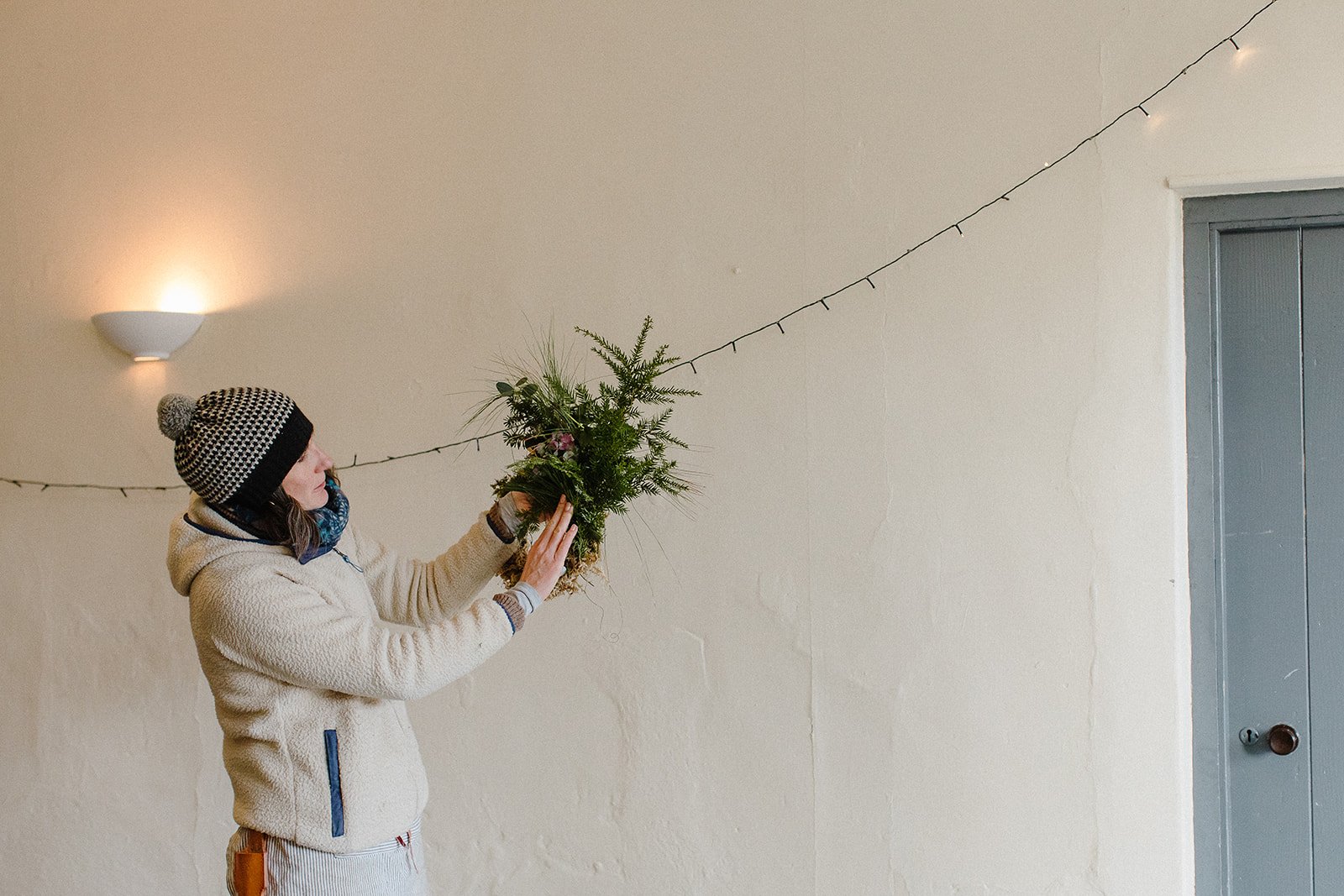
This autumn I was approached by the The Story of Emily to bring my floral design work to their Victorian Christmas events. To say I was excited at this prospect is rather an understatement. It isn’t often these days, well certainly not down in Cornwall, to get asked to deliver a brief on such a unique and large scale.
This commission was quite different from others I had worked on. The styling of the Rectory, Emily Hobhouse’s childhood home, needed to be as close to historical accuracy as possible.
Starting was probably the hardest part, I knew I had to do a lot of research to understand what the Victorian’s did to style their homes at Christmas before I could really plan the entire design. I remembered in the television series Victoria, Albert had a beautiful tree brought over from Germany to dress with decorations for their family, but they were a Royal family and getting the class of Christmas styling right is another level to consider!


The Christmas Tree
I did in the end find a very good article which spoke about elements of hand made decorations and treasures of glass baubles from travels. Tin birds with tail feathers were also very popular - can you imagine the dangers of these with the real candles they clipped to the tree!
My biggest surprise was finding out that the Victorian’s used holly to stuff their Christmas trees with. I couldn’t really get my head around this, as all I could think is you have hunted for the perfect shape tree, only to fill in all the layered gaps with dense, dark foliage! How wrong was I. I admit you really do need to have berries on the holly and I think this is why they did it - natures very own baubles. However, these days having any berries left on your holly by the time you bring it in to your home is rather a challenge. In the end of I was guarding these cut branches of holly from a very excited looking black bird which took up close residence!
For Emily’s tree and taking into consideration their social standing, I wanted it to be luxurious but with the elements of handmade to keep it a family inspired design. My evenings were spent making lengths of orange garlands and trying to keep them away from the dog, Mabel, who started to drool at their scent! Poor Mabel. My luxury items were the exquisite glass baubles. I researched for hours and hours on end! I eventually found ones that were replica’s of the Victorian era. They are hand blown, hand etched and hand painted and utterly beautiful. I very carefully strung each individual one with coloured velvet ribbon and wired them into the tree for fear of them falling off!
Whilst were are not able to light the candles (can you imagine the risk!) I really wanted to have these present instead of modern alternatives. Sometimes your eye just tricks you into seeing light if you just let it. When the natural light does come through the two windows the oranges glow and honestly this tree just made me smile so much. Three very simple elements, repeated and celebrated and I honestly want to do the same to my own….sadly there is no way I can have a tree of this scale in my little cottage!


The Garlands
Styling was kept so simple in the Victorian era and lush garlands would have adorned fireplaces. Throughout the Rectory I wanted to bring a slightly different element to each of the garlands drawing inspiration from each of the rooms styling.
For the Drawing Room both the mantle and piano were a luxury creation and oranges mirrored the garlands in the Christmas tree. The mantle garland falls to the floor with streams of ribbons and the dried teasels and pine cones dance through the arrangement.
In the Dining Room a beautiful holly tree stands with small ribbons tied throughout and the mantle is filled with pinecones and dressed in a more traditional style with large bows at either end.
For Reginald’s study I did not want to over complicate the design, the room feels obviously masculine and there is an air of authority which can’t be complicated with velvet ribbons! Therefore the garland remained paired back with teasels.


The Hallway
Unexpectedly for me, the Hallway became one of the most exciting elements to style. The discovery of The Kissing Bush is in fact a Victorian tradition both here in Cornwall and Derbyshire. They are made of two wooden hoops passing through each other and dressed with evergreen foliage and in the centre were apples, oranges or nuts to finish. I found some illustrations showing some lit with candles. I first tried making one with willow but found it too neat and in the end I opted for woven grape vine. The design was then finished with garlands of oranges, ivy and oodles of ruby red ribbon.
As there are no lights in the Rectory it is when the sun goes down that this transient space takes on the most magical feel.


The Welcome Area
In stark contrast to the Rectory I wanted to create a winter installation for the welcome area that would last beyond Christmas. This modern building is absolutely beautiful, the craftsmanship is impossible to ignore but what struck me when I arrived in this space was the huge horizontal window. Having been asked to do something suspended from the high ceiling above me I set to trying to convince the team to let me do something in the window instead!
Here we are not far from moorland and my inspiration was from the ‘windy trees’ I wanted to bring an installation that mirrored the movement of windswept branches and work with the linear view.
I dried lots of flowers from my garden, mainly strawflowers and lunaria and strung them into fine garlands. These created a light element to design. To connect the two contrasting pieces I added elements found in the Rectory, the oranges and pine cones.


The Story of Emily has their Victorian Cornish Christmas event on 14 & 15 December you can hear more about the event here and book your tickets.
A huge thank you to John Hersey who followed me around for two days as I installed this commission, capturing all these beautiful elements so I could share them with you.
Merry Christmas to you all. x